I know I haven't blogged in a while. There are currently seven posts in the queue that are in some state of being written that I started and then promptly forgot in everyday life. Tonight however, I find myself unable to sleep and need to write. Write to free my mind and try to unload the events of the last 2 days.
I have been in Norman, Oklahoma participating in the Experimental Warning Program; you can read the details in the link but the Cliff's Notes version is that we are testing ways to better display experimental weather information to aid NWS meteorologists in issuing warnings that are used to (hopefully) protect lives and property. Our project was ongoing the evening of May 24th and several tornadoes developed across Oklahoma. One was heading towards our location and was getting close enough that evacuations to the storm shelter were ordered for non-essential personnel. After it became apparent that the storm was going to miss the testing center, I went to the roof and just missed the dissipation of the tornado coming close to us but was able to see debris falling from the sky; mainly leaves but occasional pieces of housing material as well. A haunting feeling to know that we came that close to having a tornado ram into our facility.
Many of you hear on the news the intensity of a tornado rated in the Enhanced Fujita, or EF, scale. This scale is based on 41 years of research roughly being able to tie together the wind speeds inside a tornado that can cause a certain type of damage (see the link for a more detailed look). These surveys are done in most cases by employees of the local NWS Office. However, on May 24th there were so many tornadoes over such a large area that multiple teams were needed to drive and walk through the areas of damage to determine the intensity of the storms.
Because I have prior experience in surveys and was in Norman, I was asked to survey a portion of a tornado from near Calumet, OK to northeast of Piedmont, OK. This tornado so far has resulted in 7 fatalities (10 total from the 24th in Oklahoma) and unknown numbers of injuries along it's nearly 58 mile total path length. I have surveyed damage swaths before, but nothing to this extent. I cannot release too many details at this point because the discussions are ongoing, but the only time I have ever seen damage this bad was back in the late 90s near Castell, TX. The Castell tornado was so strong that it sucked asphalt pavement off the road and left little in it's path.
I guess the best way to say this is that I am haunted right now by the scenes I came upon. Peoples lives were strewn over miles of countryside, nothing much left of their homes but kindling for a fire. Cars looking as if an angry child threw them with all their strength after beating them up with a meat hammer. Horses, cattle, and pigs disemboweled across the countryside or someones beloved dog getting ready to be dumped into a hastily dug grave which is nothing more than a pit dug by a backhoe. Tree trunks with limbs gone and all that left is a trunk missing the bark and the stubs of the tree limbs sticking out as if they were some freakishly amputated arms. Household goods intermixed with dirt, grass, and who knows what else stuck in fence or barbed wire from somewhere a few miles away. I have never been in a war zone but I believe this is as close as one can get without being shot at.
Then there are the smells that linger in my nose a full day after the survey. The mix of Diesel, gear and motor oil, and other fluids from the crumpled masses of 18-wheelers. Leaking natural gas or propane. Something of a mix of fresh cut grass, freshly plowed fields after a rain, and the unmistakable smell of rotting flesh. The occasional whiff of a house that reminds me of someones home I was a guest in many, many years ago. Strong odors of pine, cedar, and other trees across the region that are split wide open. And then the dust containing God knows what; not the smell of dust like I have in Lubbock way too often, but something else that is nasty. Unclean. Ghastly.
However, the thing that haunts me the most is the fact that I had to walk through a neighborhood where search and cadaver dogs were still seeking the faint scent of a 3-year old boy missing since he was ripped from his mother's arms in their home when the tornado hit. His 12-month old brother didn't make it through the storm and his pregnant mother is in the hospital with serious injuries (unborn baby is O.K.) while his uninjured father was frantically searching from him after driving in after the tornado hit. We had to go and look and see what was left of this home, to see how the home was constructed, and to see what was left to try and determine what hellish winds were being produced by that tornado. Meanwhile, not 75 to 100 yards away was the remnants of a "safe room", a fortified haven for a different family to survive this exact same tornado without getting a scratch on them.
After the 13-hour damage survey marathon on Wednesday, I got back to my hotel exhausted but glad that I had a hotel to come home to. As I washed the red Oklahoma dust and other particles of whatever was floating in the air that afternoon off my skin and out of my hair, I kept running over what we saw. I still had to sit down and go back through all the pictures to better locate where all the damage was and how wide the tornado track will be. Will we be able to determine how strong the tornado was by my pictures and descriptions alone? Was there something I missed. What could I have done differently. I didn't get far; the internet connections were down and I was too tired to keep my mind awake so I pretty much collapsed last night and fell into a restless sleep.
Tonight however is different. I returned to my hotel a couple of hours ago after having dinner with good friends and co-workers laughing it up, having a hot meal, good beer, and times of fellowship. With a bunch of meteorologists hanging around each other, conversations naturally turned to retelling stories of previous experiences. I didn't think much of it at the time but the emotions started to "percolate" under the surface of a strong emotional facade. Tossing and turning in bed however, there is nothing to keep them in check and they hammer away at the front of consciousness. Tears have come and gone for the hell that people are having to go through even though they are shining examples of feeling blessed that they are still alive even though that is all they have right now.
The tears flow however because this morning I found out that they found the missing boy in the lake that I walked around not just 12 hours before about 400 yards from where his room was once located. The local media outlets had Ryan's face plastered on their newscasts and webpages, likely to "connect" with their audiences. For me however, a particular face is now burned into my memory as one that was taken WAY too early in his life by a force of nature I am tasked to try and predict and warn for.
There were others that didn't survive this tornado or the other ones across Oklahoma this night, or any of the tornadoes that you have seen across your news outlet or internets from across the United States this spring. However, this feels personal. More questions arise, questions I will never have answers to until I stand before Jesus and can finally ask Him. Why this young child in particular? Why take a tornado over populated areas as opposed to open country. Why turn the tornado heading straight for us where we had a large safe harbor for many people away and let it dissipate while tearing another across part of the countryside and take the lives away from a family that didn't have a safe place to go.
I cannot show them just yet but I will have some pictures that will not do justice to the sensory experience from the 24th and 25th. They may just give you enough of a glimpse into the power that I saw out northwest of Oklahoma City...and definitely serve as a reminder for me as to things that may come in the future anywhere my loved ones, family, friends, or myself may be located. However, there are too many questions that will take a long while to fade away...at least until the next tornado occurs and this meteorologist has to go out and find a different set of answers. And these, along with the other images will once again crop up...
UPDATE 5/30: I wanted to share a link from a fellow meteorologist and good friend that experienced a similar gamut of emotions and feelings; take a look at the bottom half of his essay here. The 3 May 1999 outbreak is a very similar analog to what happened on 24 May 2011. We (being the meteorological community) will continue to learn what worked well and went wrong with this event, and I must commend the people of Oklahoma for the resiliency of their spirit and mind throughout the area I surveyed. And yes, pictures are coming as soon as the Norman NWS office completes the effort in rating the tornadoes across Oklahoma. For those impatient to see the destruction for some reason, another fellow meteorologist and good friend shares these thoughts on why it is a good thing for those involved in storm ratings and assessments to take our time.
5.30.2011

12.24.2010
Mysteries of the Rifle, Part III
In quick review of this series, we've taken a look at the process of trying to diagnose why my Ruger Model 77 in the .243 Winchester caliber has had some issues with shooting both accurate and consistent groups when using both factory and hand-loaded ammunition. Initial thoughts were that the old scope was improperly mounted or damaged and thus it was replaced, and the shooting performance of the rifle improved some. Next, the trigger was worked on by reducing the amount of pull required to release the sear and fire the gun while also reducing creep. This too helped increase accuracy and consistency but not to the levels we know this rifle can shoot.
A bit more of a refresher to try and clarify what I am basing my tests on and why we are examining this case; my Dad has the same make and model of rifle as I do but manufactured 2 years earlier. Both are chambered for the .243 Winchester, have 1-in-9 inch rifling, and are primarily used for anything from small game to white-tailed deer (and possibly larger if needed). In order to cover such a large range of animals this rifle is being used for, various bullet weights are used to match the need of the game being pursued. A "heavier" bullet weight isn't needed for prairie dogs and a "lighter" bullet weight on a deer risks a very painful death (or worse, a non-lethal hit). Therefore, we have a variety of handloads that my grandfather, father, and I have developed over the last 60 years or so. Since the M77s that Dad and I have are fairly similar, we thought (perhaps erroneously) that they would shoot reasonably similar. That was until I had a bad hunting season using this rifle back in 2008 when several deer were missed, or required two shots to be put down which I find unacceptable. However, my Dad has his usual success with his M77 without any issues on loads or needing two rounds to put a deer down.
Again, before the one or two readers spout off with "Well, it was the shooter (i.e. YOU) that was the problem!". I cannot dissuade you from your opinion since we cannot sit down at a range and put your opinion to the test, but I will state that I've been hunting since I was 8-years old, know that bullet placement trumps any caliber of rifle/bullet, and am probably more than a "weekend warrior" but do nowhere near enough shooting to consider myself a pro. I'll also have a picture in a bit that might dissuade you from your opinion...but enough defending my "qualifications" if you want to call it that.
Onto the meat of this post. A few weeks after the prairie dog shoot, I returned to my parents place to decide if there was a good hunting round I could use in a month when I would first be able to head out for white-tailed deer season. My grandfather's notes have loads for various types of bullet design and weights; namely 70, 75, 80, 90, 95, 100, and 105-grain bullets from manufacturers Hornady, Speer, Sierra, Nosler, Winchester, and Remington (some of which have been LONG discontinued), mostly IMR or Hodgdon powders, Winchester brass, and either CCI or Winchester primers. The previously mentioned 75-grain Hornady Hollowpoint in front of 38-grains of Hodgdon Varget powder is our favored varmint/small game load with the 95-grain Nosler Partition in front of 42-grains of Hodgdon H4831 (or H4831SC) the preferred deer load. The time came to finally put my rifle to the test.
My test consisted of the following rounds (all with WLR primers and Winchester brass unless noted):
70-grain Nosler Ballistic-Tip in front of 45.5-grains H4350, loaded mid/late 90s by my grandfather
75-grain Hornady Hollowpoint in front of 38-grains Varget, loaded in 2000 by my grandfather
75-grain Hornady Hollowpoint in front of 38-grains Varget, loaded in 2009 by my Dad and I
85-grain Barnes Triple-shock, Federal factory ammunition (Federal brass and primers, powder unknown)
Three rounds at a time for each load with time in-between to allow the barrel to cool back to ambient temperatures, with another three rounds through my Dad's rifle and all hand-loads made from the same lot of powder, primers, and bullets and matched case weights. Here were the results for my rifle (scale reference, from the bullseye, the first thin white circle is 1/4 inch radius, first thick white line 1/2 inch, second white line is 1 inch radius, edge of black target and white paper 1.5 inches):

The two holes in the target at the top that is cut in half (sorry, bad iPhone pic on my part) were the 75gr Hornady HP loads from my grandfather. On target with about a 1/2 inch grouping, not bad and to be expected if I could pick off prairie dogs at 100-200 yards distance with few misses. But then came the "New load 75gr Hor"nady hollowpoints loaded by my Dad and I. Contrary to what the image may show, I was still aiming at the top target (center target on a grid of 3 x 3 targets), and ended up on line vertically but 2-3 inches LOW! Huh? Third group shot was the 85-grain Barnes Triple Shock/Federal factory load. All were fliers and are labeled "B" on the target. Again, these were anywhere from 1.5 to 4.5 inches LOW again AND about 2-4 inches RIGHT. WHAT??? At this point, we started to compare my dad's shots, all of which landed in 1 to 1.5 inch groups on target and anywhere from 0 to 1 inch high. Absolutely NO consistency between the loads and our rifles. We also decided not to shoot the 95-grain Nosler Partition through my rifle since my Dad was getting a 1/2-inch group on target 1 inch high and the start of hunting season was around the corner. We did decide however to use the last three rounds of 70-grain Nosler Ballistic-Tip bullets out of a box my grandfather loaded in the late 90s (the exact year escapes me, the box is at home) and were blown away by the results, a 1/2 inch group again but 3-4 inches low and 1/4 to 1/2 inch to the right. THAT is the kind of grouping we want, but about an inch high on target (and an excellent example of good consistency but poor accuracy)!
And this brings us up to where we are at now. My M77 is in the safe, unusable again this hunting season out of fear of missing or inhumanely bringing a deer down. Instead, I am using my grandfathers pre-64 Winchester M70 .243 Winchester with a 100-grain Sierra bullet and have successfully dropped a doe in her tracks at 70-yards over my Thanksgiving leave from work. We weren't able to do any further load testing since it is hunting season and I was putting a scope on a 7x57 Mauser rifle which will be a new series of posts when I bring it to the point of load development. In the spare time we did have, my Dad and I discussed all the various elements that we had taken into account so far and came up with two more items to check:
1) The reloading process
2) Barrel harmonics and optimal charge weight.
So, we will be exploring these two things next with additional posts until I figure out what the best loads/bullets are for my Ruger rifle.
A bit more of a refresher to try and clarify what I am basing my tests on and why we are examining this case; my Dad has the same make and model of rifle as I do but manufactured 2 years earlier. Both are chambered for the .243 Winchester, have 1-in-9 inch rifling, and are primarily used for anything from small game to white-tailed deer (and possibly larger if needed). In order to cover such a large range of animals this rifle is being used for, various bullet weights are used to match the need of the game being pursued. A "heavier" bullet weight isn't needed for prairie dogs and a "lighter" bullet weight on a deer risks a very painful death (or worse, a non-lethal hit). Therefore, we have a variety of handloads that my grandfather, father, and I have developed over the last 60 years or so. Since the M77s that Dad and I have are fairly similar, we thought (perhaps erroneously) that they would shoot reasonably similar. That was until I had a bad hunting season using this rifle back in 2008 when several deer were missed, or required two shots to be put down which I find unacceptable. However, my Dad has his usual success with his M77 without any issues on loads or needing two rounds to put a deer down.
Again, before the one or two readers spout off with "Well, it was the shooter (i.e. YOU) that was the problem!". I cannot dissuade you from your opinion since we cannot sit down at a range and put your opinion to the test, but I will state that I've been hunting since I was 8-years old, know that bullet placement trumps any caliber of rifle/bullet, and am probably more than a "weekend warrior" but do nowhere near enough shooting to consider myself a pro. I'll also have a picture in a bit that might dissuade you from your opinion...but enough defending my "qualifications" if you want to call it that.
Onto the meat of this post. A few weeks after the prairie dog shoot, I returned to my parents place to decide if there was a good hunting round I could use in a month when I would first be able to head out for white-tailed deer season. My grandfather's notes have loads for various types of bullet design and weights; namely 70, 75, 80, 90, 95, 100, and 105-grain bullets from manufacturers Hornady, Speer, Sierra, Nosler, Winchester, and Remington (some of which have been LONG discontinued), mostly IMR or Hodgdon powders, Winchester brass, and either CCI or Winchester primers. The previously mentioned 75-grain Hornady Hollowpoint in front of 38-grains of Hodgdon Varget powder is our favored varmint/small game load with the 95-grain Nosler Partition in front of 42-grains of Hodgdon H4831 (or H4831SC) the preferred deer load. The time came to finally put my rifle to the test.
My test consisted of the following rounds (all with WLR primers and Winchester brass unless noted):
70-grain Nosler Ballistic-Tip in front of 45.5-grains H4350, loaded mid/late 90s by my grandfather
75-grain Hornady Hollowpoint in front of 38-grains Varget, loaded in 2000 by my grandfather
75-grain Hornady Hollowpoint in front of 38-grains Varget, loaded in 2009 by my Dad and I
85-grain Barnes Triple-shock, Federal factory ammunition (Federal brass and primers, powder unknown)
Three rounds at a time for each load with time in-between to allow the barrel to cool back to ambient temperatures, with another three rounds through my Dad's rifle and all hand-loads made from the same lot of powder, primers, and bullets and matched case weights. Here were the results for my rifle (scale reference, from the bullseye, the first thin white circle is 1/4 inch radius, first thick white line 1/2 inch, second white line is 1 inch radius, edge of black target and white paper 1.5 inches):

The two holes in the target at the top that is cut in half (sorry, bad iPhone pic on my part) were the 75gr Hornady HP loads from my grandfather. On target with about a 1/2 inch grouping, not bad and to be expected if I could pick off prairie dogs at 100-200 yards distance with few misses. But then came the "New load 75gr Hor"nady hollowpoints loaded by my Dad and I. Contrary to what the image may show, I was still aiming at the top target (center target on a grid of 3 x 3 targets), and ended up on line vertically but 2-3 inches LOW! Huh? Third group shot was the 85-grain Barnes Triple Shock/Federal factory load. All were fliers and are labeled "B" on the target. Again, these were anywhere from 1.5 to 4.5 inches LOW again AND about 2-4 inches RIGHT. WHAT??? At this point, we started to compare my dad's shots, all of which landed in 1 to 1.5 inch groups on target and anywhere from 0 to 1 inch high. Absolutely NO consistency between the loads and our rifles. We also decided not to shoot the 95-grain Nosler Partition through my rifle since my Dad was getting a 1/2-inch group on target 1 inch high and the start of hunting season was around the corner. We did decide however to use the last three rounds of 70-grain Nosler Ballistic-Tip bullets out of a box my grandfather loaded in the late 90s (the exact year escapes me, the box is at home) and were blown away by the results, a 1/2 inch group again but 3-4 inches low and 1/4 to 1/2 inch to the right. THAT is the kind of grouping we want, but about an inch high on target (and an excellent example of good consistency but poor accuracy)!
And this brings us up to where we are at now. My M77 is in the safe, unusable again this hunting season out of fear of missing or inhumanely bringing a deer down. Instead, I am using my grandfathers pre-64 Winchester M70 .243 Winchester with a 100-grain Sierra bullet and have successfully dropped a doe in her tracks at 70-yards over my Thanksgiving leave from work. We weren't able to do any further load testing since it is hunting season and I was putting a scope on a 7x57 Mauser rifle which will be a new series of posts when I bring it to the point of load development. In the spare time we did have, my Dad and I discussed all the various elements that we had taken into account so far and came up with two more items to check:
1) The reloading process
2) Barrel harmonics and optimal charge weight.
So, we will be exploring these two things next with additional posts until I figure out what the best loads/bullets are for my Ruger rifle.
12.13.2010
Mysteries of the Rifle, Part Deux
In the last post, we covered up to replacing the scope on my Ruger Model 77 as my Dad and I continue to seek out some issues I have been having with consistency and accuracy of various hand loads as differentiated between his Model 77 and mine (again, both in the .243 Win caliber). It took me a while but I finally found that picture I took over the summer once we had the scope on and were testing the rifle out:

Dad put in a concrete shooting bench at the same spot my grandfather had his old wooden bench. You can see the 25-yard target for a rough bore-sight shot (and for practicing with my .40S&W Springfield XDM), and then the 100 yard target downrange. The chronograph was used to ensure consistency of the loads from shot to shot (the 3060 fps was a HOT or fast load and different from all the others I shot that day; it was the last round from some loads my grandfather put together...in 1993!). Some might notice that we don't have a shooting "sled"; one of those heavy-duty holders that you place your rifle into and lock it into place to remove the "human variable". We feel that this defeats the purpose of handloading ammunition and shooting your own rifle. You WANT to know how the trigger pull feels, what kind of recoil the load has, and to gain practice with working the action and reloading the magazine if/when needed. Yes, your shoulder will hurt after a full day of shooting, but at least you will have a better understanding of how your firearm works. But I digress...
We continued to experience a lack of consistency with the new scope but the accuracy had increased somewhat. After about 40 rounds or so through my rifle (not in series, always in groups of 3 with time in between for the barrel to cool) through the morning plus another few rounds through my Dad's M77, the issues with bad consistency and accuracy continued in my rifle while I could shoot groups under one minute-of-angle (MOA) with my Dad's rifle and same ammunition I shot through my rifle. We both felt that the trigger pull may have something to do with the lack of consistency. The factory trigger pull for Ruger M77 rifles of our eras was set somewhere between 6-7 pounds and there was a bit of creep in my trigger. Think about it this way, you know you have to pull hard on the trigger to fire the gun but at the same time, you know that the "kaboom" is coming. What would your natural tendency be? Mine is to start to cringe as that trigger starts to slide thus my attention is taken off the target to preparing for the recoil of the rifle. A lighter trigger pull PLUS some work to reduce the creep and increase the crispness of the sear release will reduce the chances of the human element coming into play and throwing the rifle off target, even by only a few millimeters.
SO, this past summer we sent my M77 off to a gunsmith that has worked on various rifles for my family over the past 30 years or so. After a one month layover at the gunsmith, the rifle returned with a MUCH improved trigger. We had asked for the trigger pull to be reduced to 1.5 pounds and it came in at that point with a very crisp release with no creep.
WHAAAAAAAAAAAAAAAT? I can already hear the gun-savvy readers response to that light of a trigger pull with their eyes probably as big as a Buick hubcap. "You can't set the trigger pull to be so light, it will go off when you bump it or drop it! That's dangerous!!!!!". Baloney. First off, basic firearm safety states that the rifle should remain unloaded until you are ready to use it. Therefore, the rifle remains unloaded when I'm driving a vehicle until it is parked and I am prepared to fire it which is usually when I'm in the place I am hunting or if I am preparing to walk to that place. In the event I am a passenger in the vehicle (as is often the case when I am out and about with my Dad on the ranch), I will load it as we never know when we will happen upon a skunk, feral hog, coyote, or some other pest. However, the safety will then be on until the rifle is pointed at the target and I am ready to fire AND it will be pointed out the window if there is some issue where the safety fails and the rifle attempts to discharge. Likewise, the safety is always on while I'm sitting in my spot for the day in case it does get bumped when I nod off or shift positions. Anyway, most rifles come with a "heavy" pull from the manufacturer because of liability concerns if something were to happen...and I bet that the gunsmithing community doesn't mind one bit because it provides a steady stream of customers!!!
Off the soapbox and back to where we were. After the return of the rifle, we sat down at the bench once again to re-sight the rifle and again had mixed results. My varmint hunting load of 75-grain Hornady Hollow-point bullets were shooting 1-groups, on-target, and consistently! I felt really good about this and we left the rifle as it was at the end of the summer because we had run out of time for shooting as the wind had increased considerably and we didn't have enough other loads prepared for a thorough testing. Another lesson learned: considerable time it takes to handload the ammunition, prepare for a shoot, conduct the shoot and comparisons, all while at the mercy of the weather (in our case at least, I'm not going to pay for an indoor range when I have one for free that is available whenever I want it!!!). I thoroughly cleaned the rifle with that fabulous Hoppes No. 9, swabbed down with sheath oil to remove fingerprints and preserve the metal and finish, and the rifle was placed into the safe until mid-October.
By this time, our annual fall-roundup was taking place at a family ranch, the one with the prairie dog problem. After taking care of our primary task with the cattle, my Dad and I headed over to the prairie dog town the last morning we were there to do our best at reducing the population a bit. After missing a coyote at well over 400 yards for my first shot of the day (it was a long shot, pun intended), Dad and I proceeded to use my Ruger M77 to dispatch quite a few prairie dogs. The numbers aren't important (don't want to offend too many PETA types out there...) but we ended up shooting another 40 rounds of the 75 grain Hornady HP loads and well over half of them landed on target at distances from 100-250 yards. I thought my problems with the rifle had been solved if I could land a round at that distance and on target as many times as I did...
However, that was not the case and will be discussed over the next couple of installments and this will bring us up to "real-time" posts as we continue to follow the mystery of my Ruger M77 .243 Winchester rifle.

Dad put in a concrete shooting bench at the same spot my grandfather had his old wooden bench. You can see the 25-yard target for a rough bore-sight shot (and for practicing with my .40S&W Springfield XDM), and then the 100 yard target downrange. The chronograph was used to ensure consistency of the loads from shot to shot (the 3060 fps was a HOT or fast load and different from all the others I shot that day; it was the last round from some loads my grandfather put together...in 1993!). Some might notice that we don't have a shooting "sled"; one of those heavy-duty holders that you place your rifle into and lock it into place to remove the "human variable". We feel that this defeats the purpose of handloading ammunition and shooting your own rifle. You WANT to know how the trigger pull feels, what kind of recoil the load has, and to gain practice with working the action and reloading the magazine if/when needed. Yes, your shoulder will hurt after a full day of shooting, but at least you will have a better understanding of how your firearm works. But I digress...
We continued to experience a lack of consistency with the new scope but the accuracy had increased somewhat. After about 40 rounds or so through my rifle (not in series, always in groups of 3 with time in between for the barrel to cool) through the morning plus another few rounds through my Dad's M77, the issues with bad consistency and accuracy continued in my rifle while I could shoot groups under one minute-of-angle (MOA) with my Dad's rifle and same ammunition I shot through my rifle. We both felt that the trigger pull may have something to do with the lack of consistency. The factory trigger pull for Ruger M77 rifles of our eras was set somewhere between 6-7 pounds and there was a bit of creep in my trigger. Think about it this way, you know you have to pull hard on the trigger to fire the gun but at the same time, you know that the "kaboom" is coming. What would your natural tendency be? Mine is to start to cringe as that trigger starts to slide thus my attention is taken off the target to preparing for the recoil of the rifle. A lighter trigger pull PLUS some work to reduce the creep and increase the crispness of the sear release will reduce the chances of the human element coming into play and throwing the rifle off target, even by only a few millimeters.
SO, this past summer we sent my M77 off to a gunsmith that has worked on various rifles for my family over the past 30 years or so. After a one month layover at the gunsmith, the rifle returned with a MUCH improved trigger. We had asked for the trigger pull to be reduced to 1.5 pounds and it came in at that point with a very crisp release with no creep.
WHAAAAAAAAAAAAAAAT? I can already hear the gun-savvy readers response to that light of a trigger pull with their eyes probably as big as a Buick hubcap. "You can't set the trigger pull to be so light, it will go off when you bump it or drop it! That's dangerous!!!!!". Baloney. First off, basic firearm safety states that the rifle should remain unloaded until you are ready to use it. Therefore, the rifle remains unloaded when I'm driving a vehicle until it is parked and I am prepared to fire it which is usually when I'm in the place I am hunting or if I am preparing to walk to that place. In the event I am a passenger in the vehicle (as is often the case when I am out and about with my Dad on the ranch), I will load it as we never know when we will happen upon a skunk, feral hog, coyote, or some other pest. However, the safety will then be on until the rifle is pointed at the target and I am ready to fire AND it will be pointed out the window if there is some issue where the safety fails and the rifle attempts to discharge. Likewise, the safety is always on while I'm sitting in my spot for the day in case it does get bumped when I nod off or shift positions. Anyway, most rifles come with a "heavy" pull from the manufacturer because of liability concerns if something were to happen...and I bet that the gunsmithing community doesn't mind one bit because it provides a steady stream of customers!!!
Off the soapbox and back to where we were. After the return of the rifle, we sat down at the bench once again to re-sight the rifle and again had mixed results. My varmint hunting load of 75-grain Hornady Hollow-point bullets were shooting 1-groups, on-target, and consistently! I felt really good about this and we left the rifle as it was at the end of the summer because we had run out of time for shooting as the wind had increased considerably and we didn't have enough other loads prepared for a thorough testing. Another lesson learned: considerable time it takes to handload the ammunition, prepare for a shoot, conduct the shoot and comparisons, all while at the mercy of the weather (in our case at least, I'm not going to pay for an indoor range when I have one for free that is available whenever I want it!!!). I thoroughly cleaned the rifle with that fabulous Hoppes No. 9, swabbed down with sheath oil to remove fingerprints and preserve the metal and finish, and the rifle was placed into the safe until mid-October.
By this time, our annual fall-roundup was taking place at a family ranch, the one with the prairie dog problem. After taking care of our primary task with the cattle, my Dad and I headed over to the prairie dog town the last morning we were there to do our best at reducing the population a bit. After missing a coyote at well over 400 yards for my first shot of the day (it was a long shot, pun intended), Dad and I proceeded to use my Ruger M77 to dispatch quite a few prairie dogs. The numbers aren't important (don't want to offend too many PETA types out there...) but we ended up shooting another 40 rounds of the 75 grain Hornady HP loads and well over half of them landed on target at distances from 100-250 yards. I thought my problems with the rifle had been solved if I could land a round at that distance and on target as many times as I did...
However, that was not the case and will be discussed over the next couple of installments and this will bring us up to "real-time" posts as we continue to follow the mystery of my Ruger M77 .243 Winchester rifle.
12.04.2010
Mysteries of the Rifle, Part I
The particulars of the mysteries we are going to explore revolve around a Ruger Model 77, Mark I in the .243 Winchester caliber. My Dad has this model manufactured 2 years prior to my M77. However, my rifle was passed down from my maternal grandfather, to an uncle, and then to me. We don't know how many time my M77 was shot, what ammo has run through it, or what environment it was kept in. The rifle was handed down to me after my uncle lost his battle with cancer and I never really shot it because I already had a .30-06 caliber rifle I used for hunting as well as a plethora of other choices from family members.
Our family has used the .243 pretty much since the caliber became available to the general public. This, along with the .250-3000 Savage and .257 Roberts were considered excellent varmint and medium-sized game calibers when they came out and these game are what we primarily hunt. However, the bulk of my grandfather's reloading work centered around the .243 and I knew that we had ample information to develop gun loads. I also wanted to keep my Ruger at home with me to have available in case opportunities arose where I needed a medium-caliber rifle. All my other rifles are locked up in a gun safe because of their sentimental and/or monetary value in them.
About three years ago, I brought the rifle with me during white-tailed deer season to see how it performed on bigger game. Up to that time, I had only used the M77 to try and contain an prairie dog infestation on some family land (the prairie dogs have chewed up 200+ acres of grassland which is now unsuitable for livestock and has had much of the topsoil blow away). Results were good with the small game and I thought that it would also be the same for larger game. Not so...
That year when I took out my M77, I had several deer that required two shots to put down which is NOT the humane way to do things. There were also several missed shots as well. I couldn't understand what was going on and we took the rifle to our range and tested it. Unfortunately the loads were shooting with no accuracy or consistency. Accuracy meaning it was not hitting where I was aiming and consistency meaning bullets land in close proximity to each other. My dad and I would resight my scope/rifle, all with the same powder load/bullet/primer combinations in the cartridge, and I could only get groups of around 2 inches. We would then take the same loads and BOTH my dad and I would achieve 1/4 to 3/4 inch groups at 100 yards with his M77 in the exact same caliber.
Initially we though the problem was with the scope. It was an old Burris variable power model and I personally am not a big fan of variable power scopes. The sight pictures was not circular; it was more of an oval and had thick cross-hairs that I didn't like as well. We also weren't sure how well the scope was mounted to the rifle so I decided to swap out the scope mount rings and scope to a Leupold FX-2 with Leupold rings. Sure enough, pulling the old scope off indicated that whatever gunsmith installed the scope had tightened the rings beyond normal torque specifications. The finish of the scope had been crushed off exposing bare aluminum and there were slight indentations on the barrel of the scope as well. Several of the scope mount screws were also slightly stripped, indicative of over-tightening.
After reading as much as I could on how to mount scopes and the arrival of the tools, rings, and scope, my Dad and I mounted it on the M77. We boresighted the rifle/scope and started to shoot once again with the same loads used in the initial testing. Accuracy increased quite a bit but the consistency was still not as good as we wanted. There was something else going on that we had to figure out and this will be discussed in the next installment.
Our family has used the .243 pretty much since the caliber became available to the general public. This, along with the .250-3000 Savage and .257 Roberts were considered excellent varmint and medium-sized game calibers when they came out and these game are what we primarily hunt. However, the bulk of my grandfather's reloading work centered around the .243 and I knew that we had ample information to develop gun loads. I also wanted to keep my Ruger at home with me to have available in case opportunities arose where I needed a medium-caliber rifle. All my other rifles are locked up in a gun safe because of their sentimental and/or monetary value in them.
About three years ago, I brought the rifle with me during white-tailed deer season to see how it performed on bigger game. Up to that time, I had only used the M77 to try and contain an prairie dog infestation on some family land (the prairie dogs have chewed up 200+ acres of grassland which is now unsuitable for livestock and has had much of the topsoil blow away). Results were good with the small game and I thought that it would also be the same for larger game. Not so...
That year when I took out my M77, I had several deer that required two shots to put down which is NOT the humane way to do things. There were also several missed shots as well. I couldn't understand what was going on and we took the rifle to our range and tested it. Unfortunately the loads were shooting with no accuracy or consistency. Accuracy meaning it was not hitting where I was aiming and consistency meaning bullets land in close proximity to each other. My dad and I would resight my scope/rifle, all with the same powder load/bullet/primer combinations in the cartridge, and I could only get groups of around 2 inches. We would then take the same loads and BOTH my dad and I would achieve 1/4 to 3/4 inch groups at 100 yards with his M77 in the exact same caliber.
Initially we though the problem was with the scope. It was an old Burris variable power model and I personally am not a big fan of variable power scopes. The sight pictures was not circular; it was more of an oval and had thick cross-hairs that I didn't like as well. We also weren't sure how well the scope was mounted to the rifle so I decided to swap out the scope mount rings and scope to a Leupold FX-2 with Leupold rings. Sure enough, pulling the old scope off indicated that whatever gunsmith installed the scope had tightened the rings beyond normal torque specifications. The finish of the scope had been crushed off exposing bare aluminum and there were slight indentations on the barrel of the scope as well. Several of the scope mount screws were also slightly stripped, indicative of over-tightening.
After reading as much as I could on how to mount scopes and the arrival of the tools, rings, and scope, my Dad and I mounted it on the M77. We boresighted the rifle/scope and started to shoot once again with the same loads used in the initial testing. Accuracy increased quite a bit but the consistency was still not as good as we wanted. There was something else going on that we had to figure out and this will be discussed in the next installment.
11.15.2010
Mysteries of the Rifle, Prologue
My family has a long history of being around firearms. More specifically, rifles. This comes from my paternal ancestors settling in the Hill Country during the German Emigration in the mid-1840s and the need to place food on the table. Although not quite as abundant back then as they are now, white-tailed deer were native to the land along with turkeys, small game, and other waterfowl. Thus, in order to provide for the family, something had to be shot. After all, cattle were worth way more for sale than for slaughter on their own table...
Well, technology evolved and it wasn't until after World War II that the surplus of powder, arms, and ammunition components made their way into the hands of the American public. My grandfather took to this new realm of handloading for the various arms that the family had and new ones that were coming onto the market. We have found records and several used targets dating back to mid 1950s with various notes about loads, rifles, and conditions. Some of these are so worn and faded that the knowledge that was on them is lost.
I remember countless times spent with my grandfather helping him go through the handloading process, take the ammo out, and shoot as I was growing up. My experience started off small of course; .22 LR (always factory ammo) and then gradually working my way up into the larger calibers with loads he had worked on for years. Memories were made to the smell of Hoppe's No. 9 cleaning solvent, smokeless powder, and the sound of grains of powder being gingerly placed into the powder scale. All this while looking around his trophy room lined with elk, caribou, a moose, bear skin, antelope, countless white-tailed deer antlers, and other game he had brought home from North American hunts. Most of all I remember the stern and firm, but loving, way he instructed me on the proper way to handle and shoot a rifle while extolling the virtues of finding the "perfect" load for a given gun. Time and care needed to be taken to figure out how to get the right combination for ammo, gun, and shooter. That and a few bruises on the shoulder from loads that were a bit to powerful for a young'un...
Unfortunately my grandfather passed away a couple of years ago and MUCH of the knowledge he had was lost as to loads and rifles. Some of this knowledge is written down in the form of odd notes in the resizer die boxes, scribbled on odd bits of paper, and always in pencil. A few we know to stay away from because of the "HOT" or "TOO HOT" comments and appropriately marked out lines in the reloading manuals. My dad was able to ask him about a few specific loads for his guns, but there are a few rifles that we have no idea what to do. Some of the powders listed are no longer made, or are different formulations in some way, shape, and form. This is where I am at now...my rifle, odd shooting characteristics, and trying to figure out what to do in order to shoot the most consistent and accurate loads possible.
So, I'm starting you on a new series or adventure as I take you on the journey to figure out how to have a rifle that is used for hunting of large game while also being able to handle smaller varmints as well. Next up, where I have been so far on this track...
Well, technology evolved and it wasn't until after World War II that the surplus of powder, arms, and ammunition components made their way into the hands of the American public. My grandfather took to this new realm of handloading for the various arms that the family had and new ones that were coming onto the market. We have found records and several used targets dating back to mid 1950s with various notes about loads, rifles, and conditions. Some of these are so worn and faded that the knowledge that was on them is lost.
I remember countless times spent with my grandfather helping him go through the handloading process, take the ammo out, and shoot as I was growing up. My experience started off small of course; .22 LR (always factory ammo) and then gradually working my way up into the larger calibers with loads he had worked on for years. Memories were made to the smell of Hoppe's No. 9 cleaning solvent, smokeless powder, and the sound of grains of powder being gingerly placed into the powder scale. All this while looking around his trophy room lined with elk, caribou, a moose, bear skin, antelope, countless white-tailed deer antlers, and other game he had brought home from North American hunts. Most of all I remember the stern and firm, but loving, way he instructed me on the proper way to handle and shoot a rifle while extolling the virtues of finding the "perfect" load for a given gun. Time and care needed to be taken to figure out how to get the right combination for ammo, gun, and shooter. That and a few bruises on the shoulder from loads that were a bit to powerful for a young'un...
Unfortunately my grandfather passed away a couple of years ago and MUCH of the knowledge he had was lost as to loads and rifles. Some of this knowledge is written down in the form of odd notes in the resizer die boxes, scribbled on odd bits of paper, and always in pencil. A few we know to stay away from because of the "HOT" or "TOO HOT" comments and appropriately marked out lines in the reloading manuals. My dad was able to ask him about a few specific loads for his guns, but there are a few rifles that we have no idea what to do. Some of the powders listed are no longer made, or are different formulations in some way, shape, and form. This is where I am at now...my rifle, odd shooting characteristics, and trying to figure out what to do in order to shoot the most consistent and accurate loads possible.
So, I'm starting you on a new series or adventure as I take you on the journey to figure out how to have a rifle that is used for hunting of large game while also being able to handle smaller varmints as well. Next up, where I have been so far on this track...
11.14.2010

11.03.2010
A LONG time coming
Editor's note - I've had this in my queue for almost a month now and kept waiting to publish it because of how events unfolded. The thoughts are the same but you can see where the changes had to be made...
I grew up in Cowtown; Fort Worth, TX. My parents made the decision to stay there because of the opportunities for my siblings and I had to expand our knowledge through great magnet schools, a lot of "culture" there, and a reasonable closeness to both my parent's families (they really wanted to live in the country). There was also an opportunity for me in another way...professional sports.
My Dad was fortunate (or unfortunate, depending on how you view it) to work for Texas American Bank through the Great Texas Bank Crash of the late 80's. One of the things that the bank foreclosed on before the great crash was a box at the old Arlington Stadium where the Texas Rangers played. There were times when customers would come into town and the bank would take them to a ballgame and I was able to tag along at times. This was my introduction to Major League Baseball.
SO many fond memories were formed when my Dad and I would go to those games. He and his co-workers introduced me to the tasty goodness and fun of cleaning chilled shrimp at the pre-game buffet. I was able to sit behind the Rangers dugout and get (notice, I didn't say catch) my first MLB foul ball when one of Dad's co-workers caught it and gave it to me (hey, I was probably around 6-8 at the time). The box seats provided some relief from the oppressive summer heat and a location so that a foul ball could land in the box. At that time, it wasn't about the intricacies of the game, keeping stats, or hand scoring a game. It was spending time with my Dad and watching these men slam (Juan Gonzales anyone) a ball out of the park with the wide eyes of a young boy. Then there was the game we went to for my birthday (not in the box seats but purchased in the outfield), the Rangers had the lead going into the top of the 9th, and thunderstorms started to roll in from the west. Nolan Ryan came in to close the game on 9 straight pitches, all strkies, and all his fastballs were over 95 MPH.
After the failure of Texas American Bank and my Dad's subsequent layoff, he and I would get the cheap outfield bleachers seats, walk into the stadium for batting practice, and listen to the theme of the Greatest American Hero play over the loudspeakers. And how could I forget all the racket we would make banging our feet on those old aluminum bleachers. As I started to get older, I began to understand the intricacies of deciding what pitch needs to be presented to the batter, shading the outfield to left or right field because of how a batter hits, and what a 6-4-3 double play is. Both he and I would take our gloves to the game in hopes of catching a home run or a ball tossed into the bleachers after the inning throw-around was done. We were jubilant when the Rangers won and sighed when they lost. Which happened a lot.
Then there were the times we didn't get to go to Arlington Stadium but would listen to the games on WBAP 820 with Mark Holtz and Eric Nadel making the calls. It could be sitting on the back porch after Dad had finished mowing the lawn on a rare pleasant summer evening in the Metromess. Countless times were spent driving to grandparents in the late summer afternoon and evenings passing the time listening to the Rangers play. And how can I forget spending August 22, 1989 on vacation in Pagosa Springs, CO, driving back to where we were staying, and managing to catch the right atmospherics to hear WBAP as Nolan Ryan struck out Rickey Henderson for his 5,000 career strikeout only to have the signal fade immediately after the strikeout was made and Holtz shouted "He did it! Strikeout number 5,000!".
But the Rangers languished in mediocrity (Thanks, R.E.). Lineups changed, Bobby V. was always the coach, and there rarely was a season where the Rangers were in contention for anything other than a sub-average year. Then came the mid/late 90s. The Ballpark in Arlington (as I will always remember it) was built and the Dollar Decker Hot Dog nights continued. The All-Star Game came and went. And the Rangers started to win. Gone were Steve Buchele, Rubén Sierra, and Pete Incaviglia. A new crop of players came in; Mickey Tettleton, Pudge Rodriguez (although he had been there a while before), Will Clark, and my personal favorite of that era - Rusty Greer. New owners were in place and Johnny Oates was the new manager. And the Rangers started to win. Not only win but win the American League West in 3 out of the last 5 years of the last century. And then lose to the evil empire of the NY Yankees. And then it was back to mediocrity once again with a bad owner (whom admitted that he cut corners like he did with the Dallas Stars), a loosey-goosey with his integrity A-dud, and a couple of managers and general managers that couldn't do much.
Why did I share all of that with you? Because I am not a "fair-weather" or "jumping on the bandwagon" or "late arrival to the party" fan. I have been and always will be a Texas Rangers fan. Part of this is due to the fond memories made with my friends and especially with my Dad, but the other part is that I have some pride in stating I suffered through the lean years now that the Rangers may have turned the corner and will move up away from mediocrity. Even if they don't, I won't jump ship to the hottest team or one of the "old vanguards" like the Cubs, Yankees, or Red Sox. The Rangers this year exemplified what teamwork and heart (The Claw and antlers!) can do when the rest of MLB teams try to buy their way to the top (not that this is bad, but it hampers the weaker/smaller teams a LOT). This team has faced adversity in so many ways and in so many different years, but they manage to pull through it (just look at the history of Josh Hamilton or Ron Washington's issues in the pre-season this year). However, I will also admit that I am a skeptic when it comes to new seasons; too many promises had been made that "this will be the year we go all the way" and then the team falls apart in the last month of play. But they proved me wrong this year and I'm delighted! Not only did they win the American League West, but they did it convincingly and by a BIG margin. And now we are on our way to theAL Divisional Series AL Championship Series WORLD SERIES baby! Congrats to my Texas Rangers, and we'll see how well we can do against San Fran.
And now here I sit after the series looking back at what has been an amazing year for the Rangers. I would argue that the umpires wanted San Fran to win the series based on some of the wacky strike zones they were calling in the games at the Ballpark in Arlington, but regardless the Rangers were out-pitched and our bats went cold at the wrong time. It is easy to lose sight that we are in fact, the American League Champions for the first time in team history and that isn't anything to forget. We faced down the Rays and yankees and made it through two of the best teams in the AL. I am optimistic that the new ownership will indeed do what it has promised and try to keep the Rangers payroll in the top quarter of MLB in order to attract and keep their best players. It also helps to hear one of the owners state that they will make sure to take care of Josh Hamilton after all he did for the team this year (sorry, I can't find the article on the Star-Telegram webpage). In a short five months, we will find out where the Rangers will go from here.
Thank you to the Texas Rangers for a heckuva ride this year, from a lifelong fan.
I grew up in Cowtown; Fort Worth, TX. My parents made the decision to stay there because of the opportunities for my siblings and I had to expand our knowledge through great magnet schools, a lot of "culture" there, and a reasonable closeness to both my parent's families (they really wanted to live in the country). There was also an opportunity for me in another way...professional sports.
My Dad was fortunate (or unfortunate, depending on how you view it) to work for Texas American Bank through the Great Texas Bank Crash of the late 80's. One of the things that the bank foreclosed on before the great crash was a box at the old Arlington Stadium where the Texas Rangers played. There were times when customers would come into town and the bank would take them to a ballgame and I was able to tag along at times. This was my introduction to Major League Baseball.
SO many fond memories were formed when my Dad and I would go to those games. He and his co-workers introduced me to the tasty goodness and fun of cleaning chilled shrimp at the pre-game buffet. I was able to sit behind the Rangers dugout and get (notice, I didn't say catch) my first MLB foul ball when one of Dad's co-workers caught it and gave it to me (hey, I was probably around 6-8 at the time). The box seats provided some relief from the oppressive summer heat and a location so that a foul ball could land in the box. At that time, it wasn't about the intricacies of the game, keeping stats, or hand scoring a game. It was spending time with my Dad and watching these men slam (Juan Gonzales anyone) a ball out of the park with the wide eyes of a young boy. Then there was the game we went to for my birthday (not in the box seats but purchased in the outfield), the Rangers had the lead going into the top of the 9th, and thunderstorms started to roll in from the west. Nolan Ryan came in to close the game on 9 straight pitches, all strkies, and all his fastballs were over 95 MPH.
After the failure of Texas American Bank and my Dad's subsequent layoff, he and I would get the cheap outfield bleachers seats, walk into the stadium for batting practice, and listen to the theme of the Greatest American Hero play over the loudspeakers. And how could I forget all the racket we would make banging our feet on those old aluminum bleachers. As I started to get older, I began to understand the intricacies of deciding what pitch needs to be presented to the batter, shading the outfield to left or right field because of how a batter hits, and what a 6-4-3 double play is. Both he and I would take our gloves to the game in hopes of catching a home run or a ball tossed into the bleachers after the inning throw-around was done. We were jubilant when the Rangers won and sighed when they lost. Which happened a lot.
Then there were the times we didn't get to go to Arlington Stadium but would listen to the games on WBAP 820 with Mark Holtz and Eric Nadel making the calls. It could be sitting on the back porch after Dad had finished mowing the lawn on a rare pleasant summer evening in the Metromess. Countless times were spent driving to grandparents in the late summer afternoon and evenings passing the time listening to the Rangers play. And how can I forget spending August 22, 1989 on vacation in Pagosa Springs, CO, driving back to where we were staying, and managing to catch the right atmospherics to hear WBAP as Nolan Ryan struck out Rickey Henderson for his 5,000 career strikeout only to have the signal fade immediately after the strikeout was made and Holtz shouted "He did it! Strikeout number 5,000!".
But the Rangers languished in mediocrity (Thanks, R.E.). Lineups changed, Bobby V. was always the coach, and there rarely was a season where the Rangers were in contention for anything other than a sub-average year. Then came the mid/late 90s. The Ballpark in Arlington (as I will always remember it) was built and the Dollar Decker Hot Dog nights continued. The All-Star Game came and went. And the Rangers started to win. Gone were Steve Buchele, Rubén Sierra, and Pete Incaviglia. A new crop of players came in; Mickey Tettleton, Pudge Rodriguez (although he had been there a while before), Will Clark, and my personal favorite of that era - Rusty Greer. New owners were in place and Johnny Oates was the new manager. And the Rangers started to win. Not only win but win the American League West in 3 out of the last 5 years of the last century. And then lose to the evil empire of the NY Yankees. And then it was back to mediocrity once again with a bad owner (whom admitted that he cut corners like he did with the Dallas Stars), a loosey-goosey with his integrity A-dud, and a couple of managers and general managers that couldn't do much.
Why did I share all of that with you? Because I am not a "fair-weather" or "jumping on the bandwagon" or "late arrival to the party" fan. I have been and always will be a Texas Rangers fan. Part of this is due to the fond memories made with my friends and especially with my Dad, but the other part is that I have some pride in stating I suffered through the lean years now that the Rangers may have turned the corner and will move up away from mediocrity. Even if they don't, I won't jump ship to the hottest team or one of the "old vanguards" like the Cubs, Yankees, or Red Sox. The Rangers this year exemplified what teamwork and heart (The Claw and antlers!) can do when the rest of MLB teams try to buy their way to the top (not that this is bad, but it hampers the weaker/smaller teams a LOT). This team has faced adversity in so many ways and in so many different years, but they manage to pull through it (just look at the history of Josh Hamilton or Ron Washington's issues in the pre-season this year). However, I will also admit that I am a skeptic when it comes to new seasons; too many promises had been made that "this will be the year we go all the way" and then the team falls apart in the last month of play. But they proved me wrong this year and I'm delighted! Not only did they win the American League West, but they did it convincingly and by a BIG margin. And now we are on our way to the
And now here I sit after the series looking back at what has been an amazing year for the Rangers. I would argue that the umpires wanted San Fran to win the series based on some of the wacky strike zones they were calling in the games at the Ballpark in Arlington, but regardless the Rangers were out-pitched and our bats went cold at the wrong time. It is easy to lose sight that we are in fact, the American League Champions for the first time in team history and that isn't anything to forget. We faced down the Rays and yankees and made it through two of the best teams in the AL. I am optimistic that the new ownership will indeed do what it has promised and try to keep the Rangers payroll in the top quarter of MLB in order to attract and keep their best players. It also helps to hear one of the owners state that they will make sure to take care of Josh Hamilton after all he did for the team this year (sorry, I can't find the article on the Star-Telegram webpage). In a short five months, we will find out where the Rangers will go from here.
Thank you to the Texas Rangers for a heckuva ride this year, from a lifelong fan.
9.20.2010
One for my friends that are fans of t.u....
This one from the good folks at XKCD.org made me chuckle once again because of the last frame...and I thought of all my t-sipper friends as well when I read that last part...

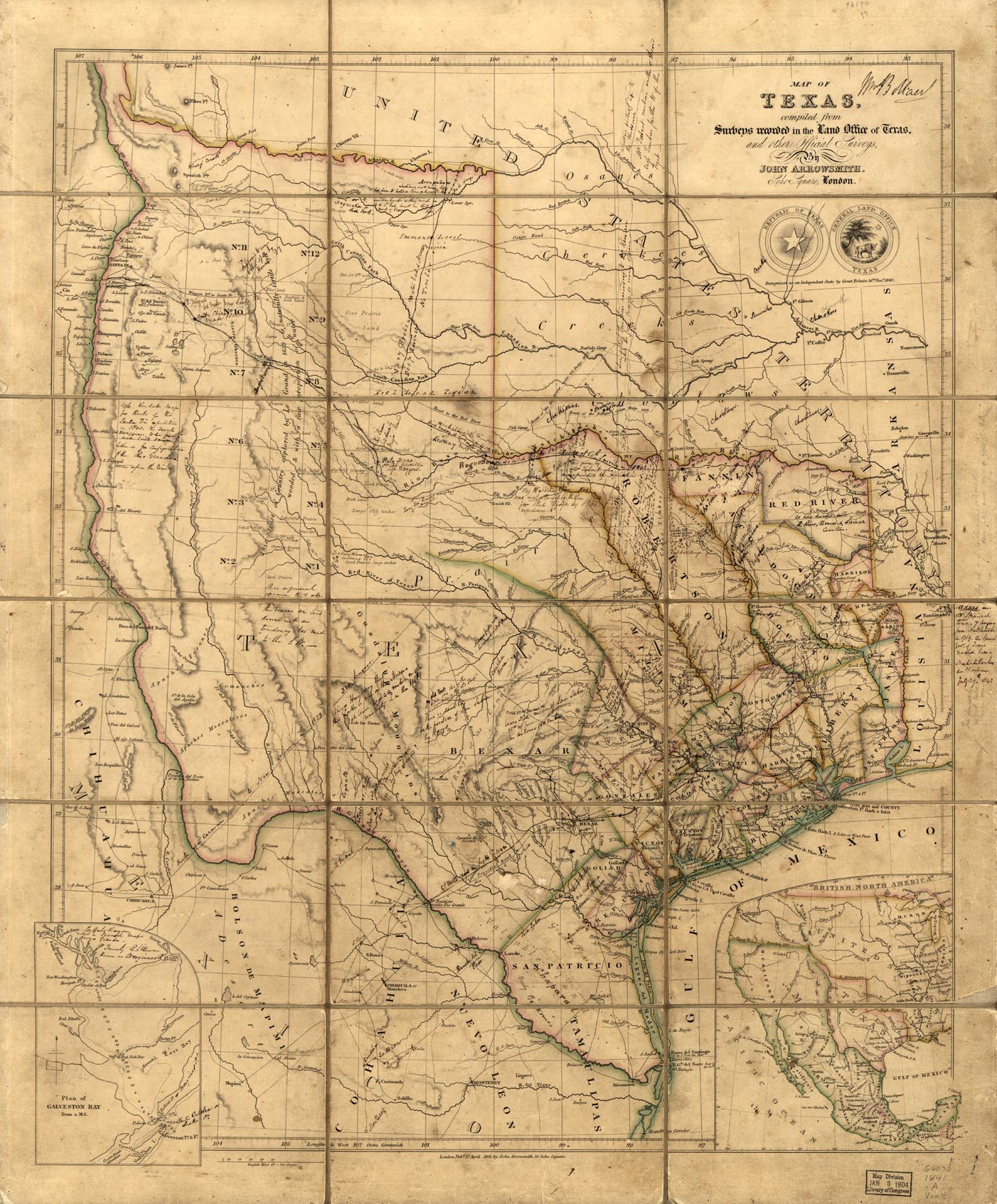
Yup, Texas technically should go all the way into Colorado, New Mexico, Kansas, and parts of Oklahoma...
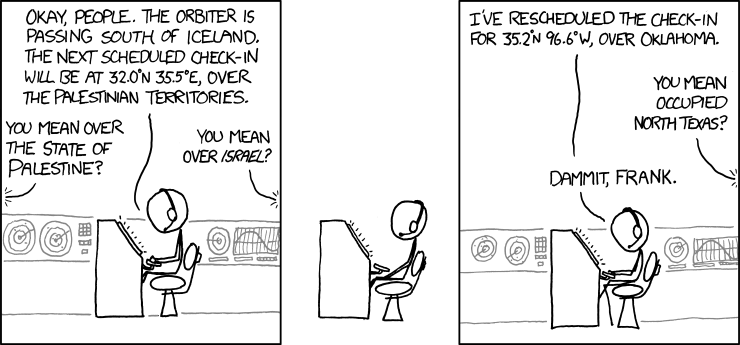
Yup, Texas technically should go all the way into Colorado, New Mexico, Kansas, and parts of Oklahoma...
9.16.2010
Still Around
Yes, I still am around but I guess you could say I have had "blogger's block". A quick perusal of my post list shows three different posts in the last 4 months that are still in the editing stage but I can't remember what prompted the thought or where I was going to go with it. Then there has been "life" - a couple of vacations to the mountains of Colorado and New Mexico, working some cattle one weekend with my family, and then some personal things I've been working through. But now I'm wrapping up a work trip to our nation's capitol and have some time to sit and put down some thoughts since there isn't anything worth watching on TV and I'm trying to figure out if I ate something I shouldn't have today.
I really like visiting Washington D.C. Being a history buff, there is something about being in the midst of what I think is living history. Not only is there all the stuff that develops and moves day-by-day, good or bad, in this town but there is also the rich history that precedes the "now". When I fly into Reagan National Airport, I look out across the city and can't help but think that our founding fathers may have walked on some of the same ground I may. How many people in benchmark/milestone/historical moments were in the various places that I was/am walking that aren't commemorated by a marker, memorial, or named street. Then there are the collections; the Smithsonian system, National Art Museum, Library of Congress, FBI, U.S. Treasury, and so on - all of which bring a wealth of educational knowledge for those who seek it out (as opposed to those who go to say they have been there or the schoolkids that view a field trip as only a day away from school). The memorials also speak to those that have come before and fought for what I more often than not and so many definitely take for granted.
The other thing I can fill up on for a bit is the "closeness" of everything. Being able to take a 10 minute walk to work (and it DEFINITELY helps that the weather is cool and relatively dry out here right now), shops, restaurants, a Whole Foods within a short walking distance, and a fairly routine scheduled mass transit system. Yes, there are cracks in this; the Metro is really showing it's age, infrastructure construction has resulted in some traffic jams which I guess slows the buses down, and you can see some areas of urban blight in the midst of the renewal that is attempting to take place in Silver Spring where I am working. I also can get my fill of a vast collection of cultures. We had lunch at an authentic Italian Ristorante two days this week and neither time was I disappointed. Then there was the outstanding Thai cuisine I had last night in Sterling with a good friend and former co-worker from the Panhandle. Basically, I need two more days to try out the Ethiopian food place that smells so good when I walk by and the Indian restaurant that from the outside looks like a dark, dingy hole in the wall but is rated 4-stars by several reviewers and locals.
If there was a way that I could manage to do it, I would come back much more often and explore all that D.C. has to offer. Matter of fact, I even made the comment to my friend that if my employer had a temporary assignment lasting a year, with close housing (basically here in Silver Spring) that allowed me to walk to work every day, and weather like we've had so far here year-round, I would have to give it SERIOUS consideration. But then after five days here, I also realize that there are so many things I miss. The trees, hills, and overall green are nice but I feel claustrophobic at times. I can't see the horizon to know what is moving in thanks to the mass of steel and concrete around me and outside of the city has trees which do the same. The cost of living is much higher here, I cannot honor our founding father's gift by practicing my rights under the Second Amendment in Maryland (or D.C. proper for that matter), and the traffic would drive me insane. Drivers here feel entitled to the road therefore normal pedestrian laws don't apply because they are running late for work, the light is still red, but they could turn right and I'm in the crosswalk and give you a dirty look, honk, or cuss you out.
I also think I'm not ready yet in other areas: how do I respond to the homeless man that follows me for a while saying I look like a rich boy and could spare some change because I walk in fancy boots? What do I do on the Metro when a stoned/drunk out of their head guy is confronting a lady because she won't take him home with her (they got off at Metro Station so I have no idea how it ended up) and I feel that it isn't a good situation? Getting in my car and driving to think or unwind; impossible with this traffic and it would be pretty hard to find a place of solitude within 15 minutes like I can back home...
Too many things to think about right now and I've got an early departure in the morning. So I bid you adieu once again Washington D.C. richer in some ways and yet empty in others. We'll see what the next couple of years bring and (Lord willing) I'll be back sometime soon.
I really like visiting Washington D.C. Being a history buff, there is something about being in the midst of what I think is living history. Not only is there all the stuff that develops and moves day-by-day, good or bad, in this town but there is also the rich history that precedes the "now". When I fly into Reagan National Airport, I look out across the city and can't help but think that our founding fathers may have walked on some of the same ground I may. How many people in benchmark/milestone/historical moments were in the various places that I was/am walking that aren't commemorated by a marker, memorial, or named street. Then there are the collections; the Smithsonian system, National Art Museum, Library of Congress, FBI, U.S. Treasury, and so on - all of which bring a wealth of educational knowledge for those who seek it out (as opposed to those who go to say they have been there or the schoolkids that view a field trip as only a day away from school). The memorials also speak to those that have come before and fought for what I more often than not and so many definitely take for granted.
The other thing I can fill up on for a bit is the "closeness" of everything. Being able to take a 10 minute walk to work (and it DEFINITELY helps that the weather is cool and relatively dry out here right now), shops, restaurants, a Whole Foods within a short walking distance, and a fairly routine scheduled mass transit system. Yes, there are cracks in this; the Metro is really showing it's age, infrastructure construction has resulted in some traffic jams which I guess slows the buses down, and you can see some areas of urban blight in the midst of the renewal that is attempting to take place in Silver Spring where I am working. I also can get my fill of a vast collection of cultures. We had lunch at an authentic Italian Ristorante two days this week and neither time was I disappointed. Then there was the outstanding Thai cuisine I had last night in Sterling with a good friend and former co-worker from the Panhandle. Basically, I need two more days to try out the Ethiopian food place that smells so good when I walk by and the Indian restaurant that from the outside looks like a dark, dingy hole in the wall but is rated 4-stars by several reviewers and locals.
If there was a way that I could manage to do it, I would come back much more often and explore all that D.C. has to offer. Matter of fact, I even made the comment to my friend that if my employer had a temporary assignment lasting a year, with close housing (basically here in Silver Spring) that allowed me to walk to work every day, and weather like we've had so far here year-round, I would have to give it SERIOUS consideration. But then after five days here, I also realize that there are so many things I miss. The trees, hills, and overall green are nice but I feel claustrophobic at times. I can't see the horizon to know what is moving in thanks to the mass of steel and concrete around me and outside of the city has trees which do the same. The cost of living is much higher here, I cannot honor our founding father's gift by practicing my rights under the Second Amendment in Maryland (or D.C. proper for that matter), and the traffic would drive me insane. Drivers here feel entitled to the road therefore normal pedestrian laws don't apply because they are running late for work, the light is still red, but they could turn right and I'm in the crosswalk and give you a dirty look, honk, or cuss you out.
I also think I'm not ready yet in other areas: how do I respond to the homeless man that follows me for a while saying I look like a rich boy and could spare some change because I walk in fancy boots? What do I do on the Metro when a stoned/drunk out of their head guy is confronting a lady because she won't take him home with her (they got off at Metro Station so I have no idea how it ended up) and I feel that it isn't a good situation? Getting in my car and driving to think or unwind; impossible with this traffic and it would be pretty hard to find a place of solitude within 15 minutes like I can back home...
Too many things to think about right now and I've got an early departure in the morning. So I bid you adieu once again Washington D.C. richer in some ways and yet empty in others. We'll see what the next couple of years bring and (Lord willing) I'll be back sometime soon.
7.17.2010
A Retirement...
New post coming but I'll leave you with this preview as a hint:
 Something to do with changing cameras...
Subscribe to:
Posts (Atom)



 Posts
Posts